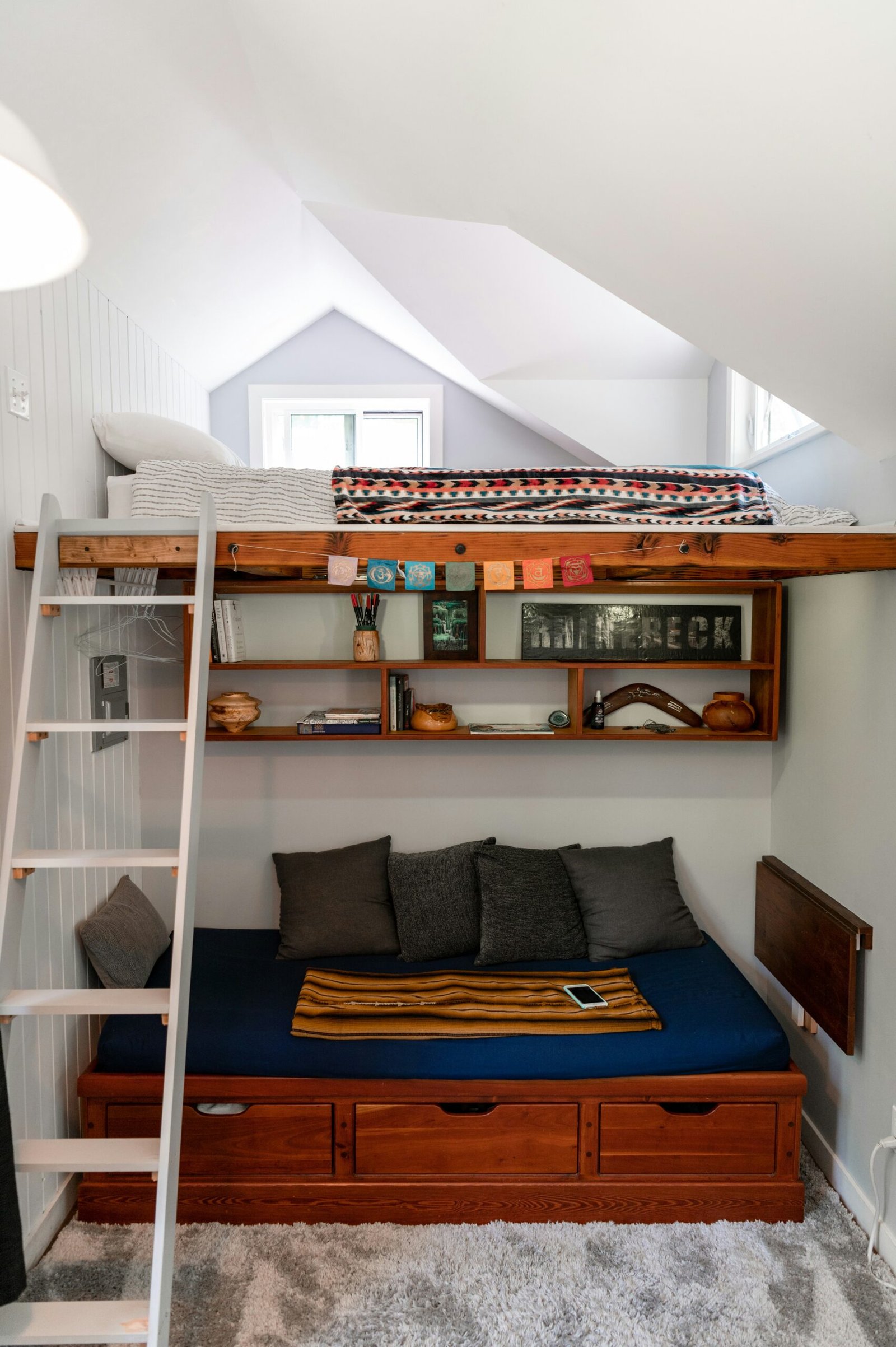

Why Build a Murphy Bed with Couch?
A Murphy bed with couch combines two pieces of furniture in the footprint of one: a bed for sleeping and a sofa or couch for daytime use. That can be useful in a tiny home or small apartment, where a dedicated bed and separate seating area may take up more room than the layout allows. In the video, Tiny House – Alaska Life describes building this bed-and-sofa combination to preserve a place to sit without giving up a full-size sleeping surface.
The intended transformation is straightforward. During the day, the bed folds upright against the wall, and its frame becomes the sofa backrest. At night, the bed lowers over the couch. The creator starts with the bed frame, then builds the bench and surrounding supports around it so the pieces can fit together.
This is a simple, low-cost experiment, not a tested universal plan. The creator says the hinge points still need to be worked out, and the available transcript ends before the finished mechanism is installed or tested. Treat the dimensions and choices here as a record of one build, not engineering specifications. This article explains the measurements shown, planning considerations, material and hardware choices, safety checks, and what the footage doesn’t establish. You can watch the original Tiny House – Alaska Life video for the construction footage.
For your own Murphy bed with couch, start by checking the mattress, room, and movement path—not by copying a cut list. The concept is useful, but the safe details depend on your own hardware, construction, and installation.
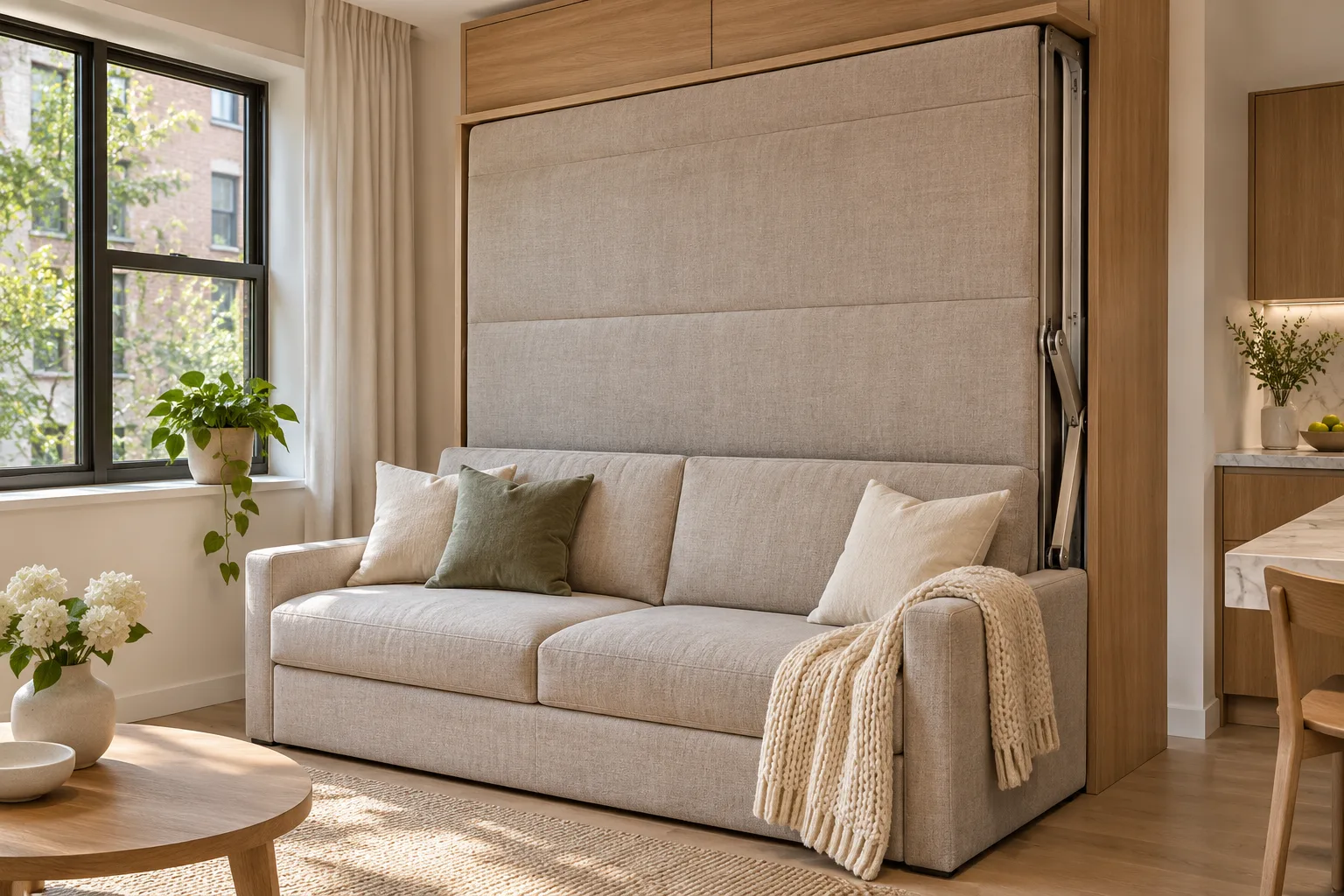
Key Takeaways from the Build
The build demonstrates a double mattress,/4-inch CDX plywood, 2-by-3 lumber for the couch frame, and six-inch-square Lazy Susan bearings as the planned pivot hardware. Those choices reflect the creator’s goal of keeping the design simple and using readily available or reused materials. They don’t establish that the assembly is safe to operate as built.
- Bed base: Two plywood pieces form the base, with frame sides and scrap supports added for assembly.
- Sofa: The creator uses 2-by-3s for the end frames and reuses old rough-cut lumber for portions of the bench and trim.
- Pivot idea: Six-inch-square Lazy Susan bearings were planned instead of specialty Murphy bed hardware; a pivot alone doesn’t provide safe lifting or locking.
- Cost: Three plywood sheets were used. The creator reports a local sheet price of over $60, but gives no complete project total.
The most useful planning lesson is to account for the actual mattress thickness and the hinge clearance before building the cabinet enclosure. The creator initially planned a nine-inch-deep wall frame based on an assumed six-inch mattress, then modified it to inches after finding the mattress was inches thick.
This Murphy bed with couch remains an in-progress build in the footage. The transcript doesn’t show completed installation, wall mounting, final lifting hardware, or operating tests. Use the video as a design example, then make your own verified plans and safety decisions before building.
Plan the Murphy Bed with Couch Around the Mattress
Measure the mattress you’ll actually use before cutting lumber. The creator’s double mattress is described as by inches, and those are the intended inside dimensions of the frame. For the base, the video shows two pieces cut to by inches, long sides cut to inches, and short sides cut to and/16 inches. These are measurements from this particular project; they aren’t a ready-to-use plan for every mattress sold as double or full.
Use a worksheet to adapt the concept to a twin, full, or queen mattress. Record the mattress’s measured width and length, then decide on the frame thickness, side clearance, hinge space, and cabinet depth. Keep the mattress dimensions separate from the frame’s outside dimensions. Include the thickness of side supports and bearings when calculating the bench width, as the creator does when adding and/8 inches to the frame measurement.
- Measure the mattress in more than one place and use the largest reading.
- Set frame inside dimensions based on the mattress and the clearance recommended by your chosen hardware.
- Add the frame material and support thickness to establish outside dimensions.
- Draw the bed both upright and lowered, including the sofa, cabinet enclosure, and movement path.
- Check ceiling height and overhead obstacles with the bed upright; check floor clearance and the bed’s landing area when lowered.
Don’t infer room-clearance figures from the video; it provides no universal ceiling or floor dimensions. Measuring and planning should also account for cabinet shelves and drawers, if you want them, so storage won’t obstruct the moving bed or the hardware. A Murphy bed with couch needs clearance for the entire assembly, not only a mattress-sized opening.
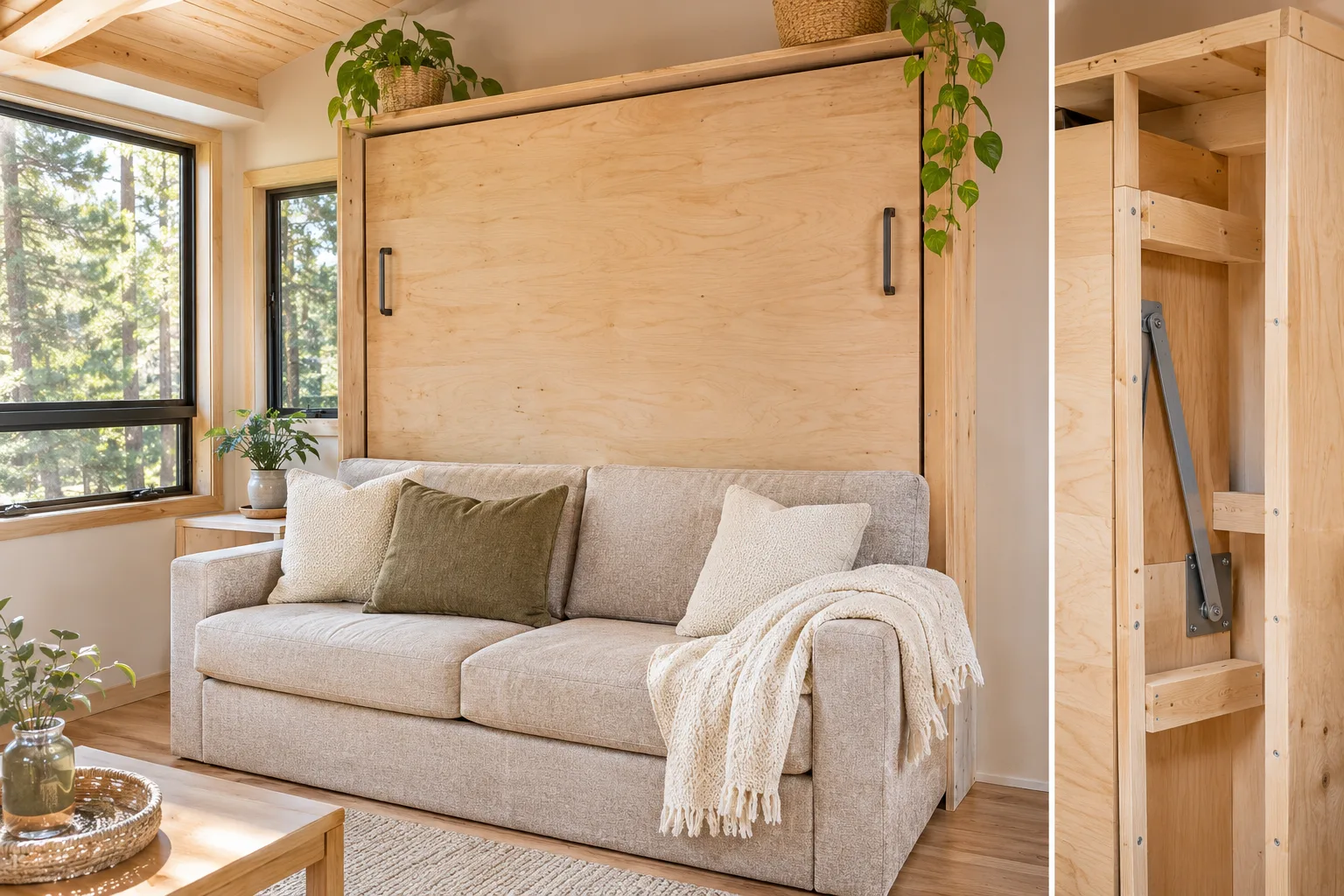
Choose Materials, Tools, and a Realistic Budget
The demonstrated materials are/4-inch CDX plywood, 2-by-3 lumber, screws, scrap wood, stain, and a protective finish. Tiny House – Alaska Life also reuses rough-cut lumber from an old cabin for parts of the couch. The creator chose CDX partly to control cost, noting that a sheet cost over $60 locally and that the build used three sheets. That figure is a local price reported in the video, not a current or complete project budget.
The planned pivot was six-inch-square Lazy Susan bearings rather than specialty Murphy bed hardware. That alternative may serve as a pivot point, but it does not by itself handle lifting assistance, secure holding, or locking. Compare the total cost of suitable hardware with the cost of the wood before deciding that a DIY build will be cheaper. IKEA furniture and the Moddi Murphy Bed are comparison points to investigate when weighing ready-made furniture or plan-based alternatives; the video makes no claims about their prices or performance.
Tool checklist based on the work shown:
- A circular saw for ripping plywood and cutting parts.
- A power drill and screwdriver for pre-drilling and fastening with screws.
- A finish nailer for trim and other non-structural pieces.
- A measuring and marking setup for checking dimensions and laying out cuts.
Wood glue may be considered as part of a suitable joinery plan, but the transcript specifically demonstrates pre-drilling and screws; it doesn’t establish a glue schedule. A staple gun is not shown. It might be useful for a separately planned upholstered cushion finish, where foam cushions, batting, and upholstery fabric need securing, but those materials and that process aren’t demonstrated.
Make an itemized budget for plywood and lumber, bearings or a complete bed mechanism, fasteners, finish, cushions, and wall-mounting hardware. Add a line for changes caused by mattress thickness. This Murphy bed with couch has no published complete total, so avoid treating the plywood price as the cost of the whole project.
Build the Bed Frame and Sofa as One System
The creator builds the bed base from two plywood panels, joins them with the surrounding frame pieces, and adds five evenly spaced strips cut from scrap plywood to help hold the base together. The video recommends pre-drilling plywood before driving screws: without a pilot hole, the material may split, potentially weakening the assembly. The creator also advises choosing which plywood face will be visible before fastening the frame, even when using CDX.
The couch end frames are made from 2-by-3 lumber. The stated seat height is inches, and the armrests are planned to finish about seven inches above the seat, depending on cushion and trim. Each end frame is planned at by inches. For the bench, the creator calculates a top and/16 inches wide by inches deep. That width accounts for the bed-frame measurement, the bearings, and/4-inch plywood side supports.
Measure the complete assembly rather than sizing the bench from the mattress alone. Frame sides, bearing thickness, and supports all affect the space between the armrests. The video’s measurements explain its layout; they don’t replace checking your own parts before final cuts.
Keep structural and finish fastening distinct. Screws are used for the frame assembly, while the creator uses a finish nailer for trim and other non-structural work. Don’t treat these quick-build choices as engineering specifications: choose joinery, fasteners, and materials suited to the moving loads and follow the hardware maker’s requirements. This Murphy bed with couch is a connected system, so a change to one component can affect the fit of the others.
Design the Sofa Backrest and Folding Clearance
The planned arrangement turns the upright bed frame into the sofa backrest. When lowered, the bed rests over the couch. That approach differs from a conventional sofa bed: the bed stays vertical during the day, but you need a clear path to lower it and a deliberate plan for anything on the seat.
The creator leaves a gap behind the bench and space for the bed to rotate down into position. In the video’s explanation, the pivot sits near the back of the sofa, and the bed needs room to swing through its arc before it can rest on the bench. The side supports also have to accommodate the frame and its hinge clearance. Don’t close in this gap or add trim until you’ve checked the full movement path on your own design.
The footage does not show finished cushions or an upholstery process. Plan those details separately: decide whether seat cushions will be removed, repositioned, or stored before lowering the bed. If you add foam cushions, batting, and upholstery fabric, make sure their thickness and placement don’t obstruct the moving frame. Consider a dedicated storage spot, but keep cabinet shelves and drawers clear of the mechanism and its travel path.
Before construction, sketch the sofa in both modes and mark where the cushions go. Then check that the raised bed creates a usable backrest and that the lowered bed clears the arms, wall, floor, and any nearby furniture. A Murphy bed with couch can preserve daytime seating, but it requires more deliberate cushion handling and clearance planning than a fixed sofa.
Select a Bed Mechanism and Mount It Safely
Lazy Susan bearings are the pivot choice planned in the video, not a complete, verified Murphy bed mechanism. Bearings may allow rotation, but they don’t establish that a heavy bed will lift safely, stay upright, lock, or lower under control. The transcript doesn’t show gas struts, a completed spring system, or final mechanism testing.
Choose a bed mechanism rated for the combined moving load of the frame and mattress. If comparing springs with gas struts, follow the specific maker’s capacity, installation, orientation, and adjustment instructions. Don’t select components by appearance or assume that a pivot bearing can replace lifting assistance. Install and calibrate only as the mechanism’s instructions allow; if the required load or installation method is unclear, consult the manufacturer or a qualified professional.
Wall mounting and tip-over prevention are essential checks. Locate wall studs, confirm the cabinet enclosure’s connection to the building, and use suitable rated fasteners for the structure and the manufacturer’s instructions. A heavy moving bed can impose forces beyond the static weight of a cabinet, so don’t operate an unanchored enclosure or rely on unsupported assumptions about wall strength.
The creator planned a support shelf or folding legs for the lowered bed and a bolt to lock it upright. These features are described as future modifications, not completed or tested results in the available transcript. For your Murphy bed with couch, specify what supports the bed in each position, how it locks, and how it can be released safely before building the enclosure around it.
Test, Inspect, and Maintain the Moving Bed
The transcript stops during construction, before final installation and operating tests. The following sequence is additional safety guidance, not a result demonstrated by the creator. Don’t put a newly built bed into regular use until its mechanism, supports, and wall attachment have been checked.
- Inspect before movement: Check frame joints, screws, bearing or hinge fasteners, support legs, locking hardware, and wall fasteners. Confirm the cabinet is securely anchored.
- Clear the path: Remove cushions and objects from the bench and floor. Check overhead and side clearance before moving the frame.
- Follow the mechanism instructions: Test without a mattress only if the manufacturer permits that procedure. Keep people clear of pinch points and don’t force a sticking mechanism.
- Add the intended load carefully: If the mechanism’s instructions allow, add the mattress and other intended load in a controlled way, checking for smooth, even movement.
- Verify both positions: Confirm that the bed locks securely upright and rests on its planned supports when lowered.
Inspect moving parts regularly, including hinges or bearings, springs or gas struts, bolts, screws, support legs, and wall fasteners. The video specifies no inspection interval, so follow the hardware maker’s maintenance instructions and recheck after any adjustment or sign of movement.
Binding, uneven movement, loose fasteners, unusual sounds, or a bed that won’t stay in position are reasons to stop using it. Consult the mechanism instructions or a qualified professional rather than trying to compensate with improvised adjustments. These checks matter for any Murphy bed with couch because the moving assembly and its supports must work together reliably.

Conclusion: Make the Measurements and Safety Plan First
Tiny House – Alaska Life shows how a double bed, plywood frame, 2-by-3 couch, and reused lumber can be brought together as a space-saving furniture concept. The most transferable lessons are to measure the real mattress, account for mattress thickness and hinge clearance early, and size the sofa around the complete bed assembly. The creator’s change from a planned nine-inch wall frame to a 12-inch frame after discovering a 10-inch mattress illustrates why those checks matter.
Before you cut material, write down your mattress dimensions, frame dimensions, cabinet depth, sofa size, and required clearances. Choose a complete mechanism rated for the moving load, plan secure wall mounting, and decide how the bed will be supported and locked in both positions. Price the materials and hardware separately; the video gives a plywood price and sheet count, not a full project cost.
Finally, treat the build as unfinished until it has been anchored, tested according to the mechanism instructions, and inspected. The video is useful inspiration, but it doesn’t provide completed plans or verified operating results. For the next step, watch the source footage, draw your own dimensioned layout, and confirm the hardware and mounting requirements before construction.
Key Takeaways
- The demonstrated build uses a 54-by-75-inch double mattress,/4-inch CDX plywood, 2-by-3 couch framing, and planned six-inch-square Lazy Susan bearings.
- Measure the actual mattress and account for frame thickness, hinge clearance, cabinet depth, and cushion handling before cutting.
- A pivot bearing is not a complete lifting or locking mechanism; select rated hardware and plan secure wall mounting and supports.
- The creator reports using three plywood sheets and a local price over $60 per sheet, but provides no complete project budget.
- The available footage ends before final installation and testing, so its dimensions and construction choices are not verified universal plans.
Frequently Asked Questions
What's better, a Murphy bed or a sofa bed?
It depends on your room layout and how you want to trade off a separate sofa, a folding bed, and daily setup. A Murphy-style layout keeps the bed upright during the day but needs a clear lowering path and a plan for moving cushions; a sofa bed has a different folding arrangement.
How to do a DIY Murphy bed?
Measure the mattress and room, draw the frame and cabinet enclosure, and choose a compatible mechanism rated for the moving load. Build to verified dimensions, anchor the enclosure securely, and test the finished assembly according to the hardware maker’s instructions before regular use.
How to convert a bed to a couch?
In the video’s concept, raise the bed against the wall so its frame acts as the sofa backrest, with a suitable bench seat underneath. Plan where seat cushions will go before lowering the bed, and make sure they won’t obstruct the moving frame.
Is it cheaper to buy or build a Murphy bed?
The creator aims to keep costs down with basic materials, reused lumber, and planned Lazy Susan bearings, but the video doesn’t give a complete project total. Compare the full cost of lumber, suitable lifting hardware, fasteners, finish, cushions, and wall-mounting supplies with the alternatives you’re considering.