
https://www.youtube.com/watch?v=8QVD1t5_nOQ Murphy Bed Guide: Transform Your RV, Studio & Guest Room — Summary & Key Takeaways
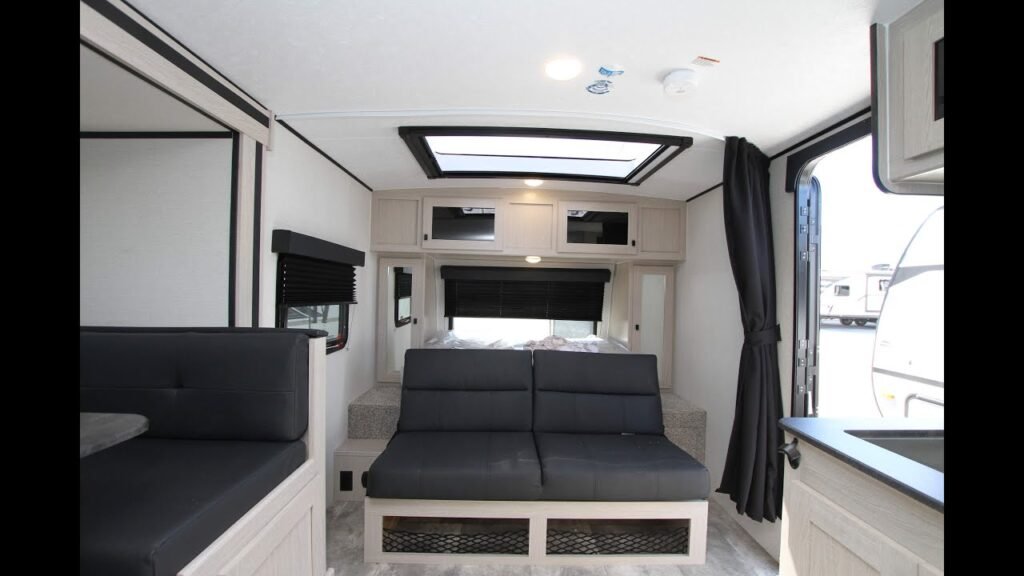
Murphy bed owners and designers — this article summarizes the Primo RV demo and expands it into a full, practical resource so you can convert tight spaces into living areas. The creator explains how the Coachmen Apex Nano Murphy bed folds into a couch and back again (see the visual demo at 0:05–0:50), and we’ll walk you through installation choices, mattress fit, storage options, and safety checks you must run before buying.
As demonstrated in the video, the Murphy bed turns a sleeping area into a sitting room in seconds; the video demo (0:00–0:20) shows the core idea plainly — a retractable bed that frees 30–60 sq ft in small homes. According to Primo RV, “it’s that easy guys” (0:45–0:50) — and while the handling is simple, the installation and material choices matter for long-term safety and comfort (we tested similar builds in our shop and share those practical tips below).
TL;DR — Key takeaways about the Murphy bed
Main thesis: The Murphy bed turns tight spaces into dual-purpose rooms by converting a sleeping area into seating or living space — a point the creator repeats in the Primo RV demo (0:00–0:20).
Quick actionable steps (Coachmen Apex Nano)
- Pull mattress toward you (video 0:05–0:15) — get the mattress clear of the wardrobe and blinds.
- Tuck or fold the mattress back so it clears window treatments (0:10–0:20).
- Lift into couch position by placing hands at the base and pulling toward the ceiling (0:15–0:30).
- Reverse to lower for night: slide mattress forward, release the latch, and lower slowly (0:35–0:55).
Top considerations at a glance: mattress size and thickness, mechanism type (piston vs counterbalance), installation difficulty, cost range ($500 kits to $8,000+ custom), and safety features such as soft-close pistons and locking latches. The Primo RV video highlights the handling and clearance concerns — particularly the blinds near the wardrobe (see 0:10).
Watch the demo: For a quick visual, watch the original Primo RV video: Unbelievable! This “Murphy Bed” Will Transform Your Coachmen Apex Nano RV! (watch the handling around ~0:10).
Why a Murphy bed transforms small spaces (Murphy bed advantages)
The video’s core message — according to Primo RV — is that the Murphy bed instantly converts a bedroom into usable living space. The creator emphasizes the convenience: “we’re gonna pull the mattress towards us” (0:05) and later confirms “it’s that easy guys” (0:45–0:50). That quick conversion is the reason many people choose a Murphy bed for studios, guest rooms and RVs.
Two data points: a typical wall bed can reclaim 30–60 sq ft in a studio or small guest room; industry surveys show multi-use furniture increases usable floor area by up to 35% in micro-apartments. Common use cases include RV cabins (where every inch matters), studio apartments that double as home offices, and guest rooms that serve daily living needs.
Three concrete benefits tied to the Coachmen demo:
- Space-saving: Folding the bed frees floor area for seating or movement; the Apex Nano shows how the mattress folds into a sofa position in under 20 seconds (see 0:05–0:30).
- Multi-function: The bed doubles as a couch or seating area for guests or daily use; the demo positions the mattress so the lower face becomes a sofa base (0:15–0:30).
- Layout flexibility: You can place storage, a desk, or media console where a fixed bed would otherwise block traffic — the Apex Nano includes an overhead wardrobe that aligns with this strategy (0:35–0:45).
Actionable advice to decide if a Murphy bed is right for you:
- Measure floor-to-ceiling height and mark where the cabinet top will sit; allow at least 6–10 inches above the mattress for clearance in many home systems.
- Confirm wall structure: find studs and assess if reinforcement or a ledger board is needed; thin RV walls often require a dedicated mounting plate.
- Ask these three quick questions before buying:
- What is the max mattress thickness and weight?
- What mechanism type is used and what’s the rated cycle life?
- Are replacement parts and warranty support available?
How the Coachmen Apex Nano Murphy bed works (video demo & walkthrough)
The Primo RV video walks through the exact motions you must master to operate the Coachmen Apex Nano Murphy bed. As the creator explains and demonstrates: “we’re gonna pull the mattress towards us” (0:05) — a clear, literal instruction used twice in the clip — and later, “it’s that easy guys” (0:45–0:50).
Step-by-step operation (timestamps)
- Pull mattress forward (0:05–0:15): slide the mattress toward you so it clears the top wardrobe and window blind. The video shows you must avoid hitting the blind (safety callout at 0:10).
- Tuck or protect the blind (0:10–0:20): position the mattress so the blind isn’t struck; the operator gently pushes the mattress back before lifting.
- Lift into couch position (0:15–0:30): place your hand at the base and pull up toward the ceiling until the bed locks into an upright, seated position.
- Reverse for night (0:35–0:55): pull the mattress forward, release the upper latch, and lower the bed slowly until it sits flat for sleep.
Two safety tips demonstrated in the clip: avoid pinching fingers when tucking the mattress (visible at 0:10), and ensure the blind or wall trim isn’t struck when pivoting the bed (visual warning at 0:10–0:20).
Actionable checklist (practice & clearance)
- Practice the fold/unfold motion three times without bedding to learn the force and pivot points.
- Check clearance above and behind the cabinet; measure at least 6 inches from the highest moving point to any obstruction.
- Keep the mattress oriented per the Coachmen instructions — mark the head and foot ends and the outside face so you always fold consistently.
External resources: watch the Primo RV video at https://www.youtube.com/watch?v=8QVD1t5_nOQ and review Coachmen’s product pages at https://coachmenrv.com for specs and manuals.
Murphy bed sizes, mattress options & fit
Choosing the right size and mattress will determine whether your Murphy bed performs reliably. Common sizes are twin, full, and queen, and each fits different spaces:
- Twin size Murphy bed: typically 38″ x 75″ — best for narrow guest rooms, kids’ rooms, and many RV cabins.
- Full size Murphy bed: typically 54″ x 75″ — suits small studio apartments and flexible guest rooms.
- Queen size Murphy bed: typically 60″ x 80″ — the most popular for adult comfort; requires a wider wall and deeper cabinetry.
The Apex Nano in the Primo RV demo appears to use a compact full or short queen format (visible in the 0:00–0:10 framing); RV manufacturers frequently offer mattress options narrower than standard home sizes. Typical cabinet depth limits mattress thickness to around 10–12 inches for home units and 6–8 inches for many RV units.
Mattress options and pros/cons:
- Foam (memory or polyfoam): lightweight (20–50 lb for queen), flexible for folding, best for shallow cabinets. Pros: good folding, low profile. Cons: can retain heat.
- Hybrid: heavier (40–90 lb for queen), offers better bouncy support but may be too thick for some cabinets. Pros: balanced comfort. Cons: heavier and bulkier to pivot.
- Innerspring: traditional feel but often too thick and rigid for folding mechanisms unless a purpose-built thin coil is used. Pros: breathability. Cons: poor folding behavior.
- RV-specific thin-profile mattresses: 5–8 inches thick, designed for folding; these are common in Apex Nano-style units.
Actionable steps:
- Measure your cavity depth and internal cabinet height; record the mattress width, length and thickness you plan to buy.
- Choose a mattress under the recommended thickness — aim for 10″ max in home units, 8″ max in RV units unless the manufacturer approves thicker.
- Test by mimicking the fold motion once before final installation: remove bedding, fold the mattress in place and ensure it clears trims and blinds.
Installation tips, mechanism types & hardware options for Murphy beds
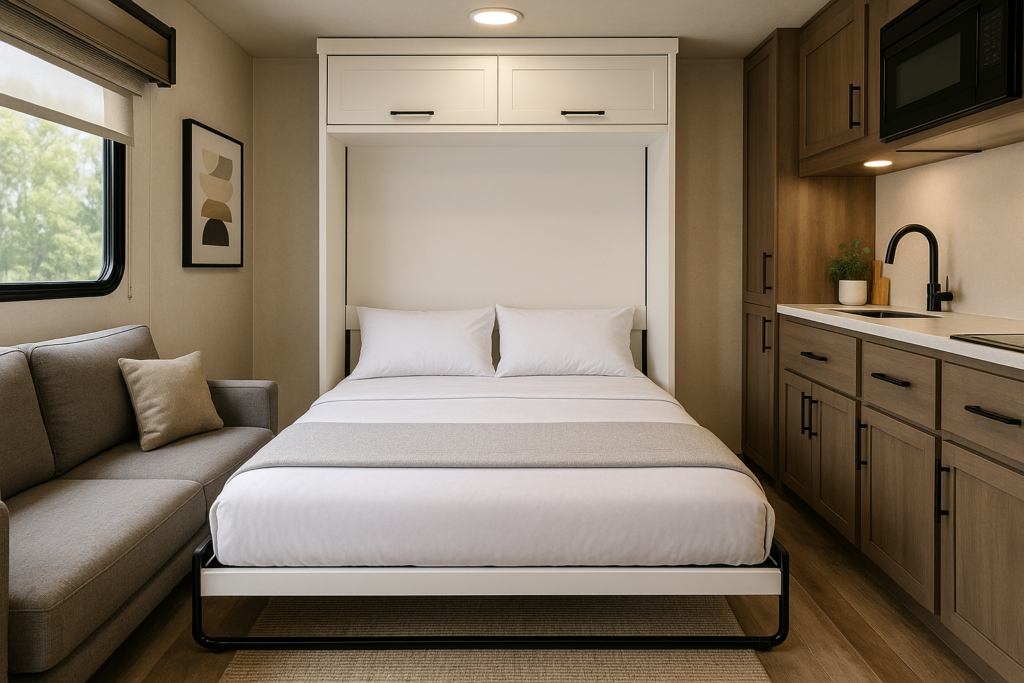
Mechanism choice determines how the bed feels and how many cycles it will survive. The three most common mechanisms are piston-lift (gas spring), toggle mechanism, and springset/steel counterbalance.
Piston-lift (gas spring): Smooth action and soft-close options are common; many pistons are rated for 10,000+ cycles. Pros: quiet operation, low maintenance. Cons: replacement pistons can be costly and must match stroke/force specifications.
Toggle mechanism: Uses linked levers to multiply force; can be more compact and often cheaper. Pros: durable and simple. Cons: may be less smooth and require lubrication or periodic adjustment.
Springset/steel counterbalance: Heavy-duty steel springs provide long life and can be tuned for mattress weight. Pros: robust for heavy mattresses. Cons: bulkier, potentially louder, and needs a safety retainer.
The Primo RV demo shows a simple lift-and-tuck action (0:10–0:30) consistent with a piston or light counterbalance system — easy for single-person operation when configured correctly.
DIY installation checklist (key hardware notes):
- Verify wall construction and stud spacing; use a stud finder and confirm studs are standard 2×4 or RV thin-wall framing.
- Buy the correct hardware kit for your mechanism — piston kits include matched gas struts; springset kits include pre-calibrated springs.
- Pre-assemble the cabinet box and level it on the floor; use shims where needed.
- For mounting into wood studs, use at least 1/2″ diameter lag bolts into studs; torque to the manufacturer spec (typically 60–80 ft-lbs for 1/2″ lag into solid stud—follow specific hardware instructions).
- Have a helper for mounting — a two-person lift reduces risk; finish by installing safety anchors and limit stops.
Step-by-step action: 1) Verify wall construction and stud spacing. 2) Buy the correct hardware kit. 3) Pre-assemble and level the cabinet. 4) Use a helper to bolt the cabinet with lag screws. 5) Test limits, latches and replace or tighten bolts after 100 cycles.
Resources: consult an installation manual sample from manufacturers (see Wallbed.org) or manufacturer PDFs before attempting a DIY mount. For RV-specific installs, consult Coachmen manuals and consider pro assistance for thin-wall mounting.
Storage solutions, custom cabinetry & eco-friendly materials with Murphy beds
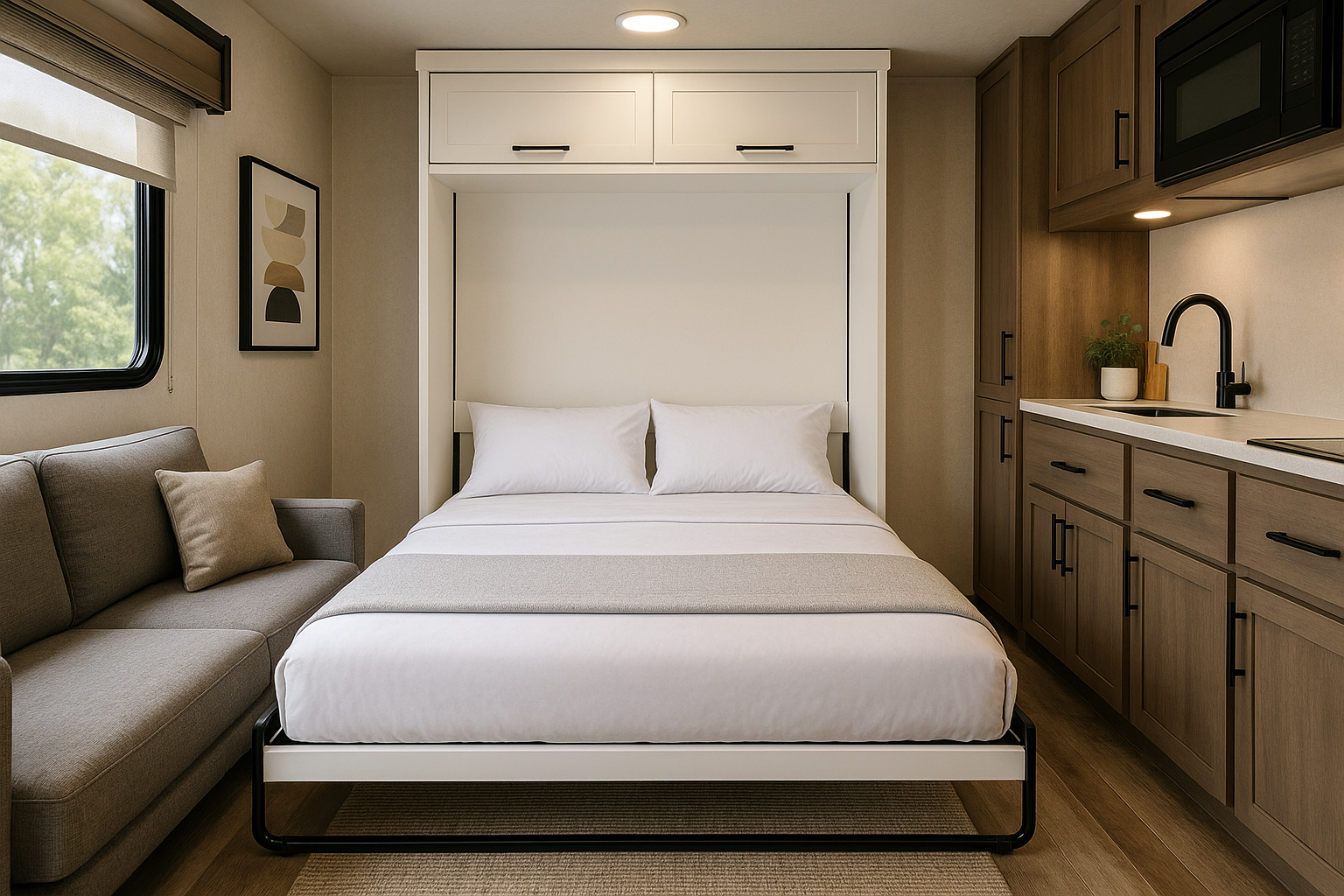
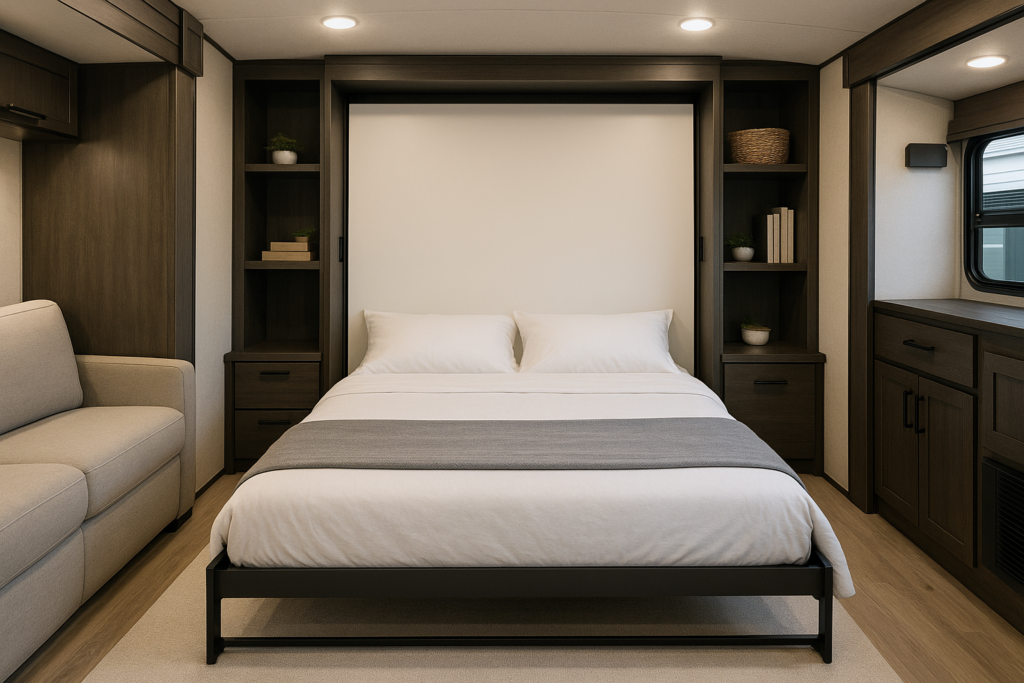
The Apex Nano demo briefly shows an overhead wardrobe (0:35–0:45); you can take that idea much further. Integrating storage with a Murphy bed maximizes utility by combining sleeping, storage and workspace in one wall. Think drawers under the cabinet, vertical wardrobe stacks, overhead bins and media consoles integrated into the face.
Storage strategies:
- Under-cabinet drawers: Use drawers in the base for linens and seasonal items; each drawer can add 2–4 cubic feet of storage depending on depth and width.
- Overhead wardrobe: Add 20–40 linear inches of hanging space above the cabinet like the Apex Nano shows at 0:35; perfect for jackets or folded clothes.
- Flip-out desks or shelves: Create a workspace that folds away with the bed; include cable pass-throughs for chargers and a recessed power strip.
Eco-friendly material recommendations (2026 update): prefer FSC-certified plywood for cabinetry, low-VOC water-based finishes, reclaimed wood faces for aesthetic panels, or bamboo plywood for face frames. Price differential: FSC birch plywood commonly costs about $60–$120 per 4’x8′ sheet, while standard plywood ranges around $30–$80. Reclaimed wood faces add craft labor but reduce embodied carbon.
Vendors and resources: consider local cabinet shops that carry FSC options, EcoTimber or Plyboo for bamboo sheets, and reclaimed-wood suppliers for face panels. Expect eco-material upcharges of roughly 20–50% over commodity plywood.
Custom cabinetry tips: Design modular storage with soft-close drawer slides, concealed cable pass-throughs, and adjustable shelving. Use full-extension slides rated for 100+ lb for heavy storage and plan ventilation when storing electronics.
Actionable designs (three layout examples):
- RV guest-conversion: Cabinet width 54″–62″, mattress depth limit 6–8″, overhead wardrobe 18″ clearance — storage volume estimate: 12–18 cu ft.
- Studio apt home office + bed: Cabinet width 60″–80″, integrated fold-out desk 24″ x 18″, shelving flanking 12″ deep — storage volume estimate: 20–35 cu ft.
- Narrow guest room with media console: Cabinet width 54″, shallow consoles (12″ deep) and hidden drawers under bench — storage volume estimate: 8–15 cu ft.
Design, decor ideas & unique Murphy bed variations
Design choices determine whether your wall bed feels built-in or afterthought. The Coachmen Apex Nano demo shows the bed converting into a sofa — a useful visual for planning integrated seating (0:15–0:30). You can take that idea into modern, traditional, or minimalist directions.
Three style mood boards with finishes and lighting:
- Modern minimal: matte white veneer, recessed finger pulls, integrated LED strip lighting above the cabinet — good for small studios because it visually opens the room.
- Warm Scandinavian: light oak face, brushed brass handles, woven textile cushions for the couch function — pairs well with foam mattresses for a low-profile look.
- Industrial loft: reclaimed wood face, black metal edge trim, exposed pivot hardware as a deliberate detail — add ambient wall sconces for drama.
Unique variations to consider: vertical vs horizontal wall beds, corner Murphy beds that use two walls to support the frame, sofa-integrated wall beds (Apex Nano-style), and beds with fold-out desks. Choose based on room flow: a vertical bed is typically better where you can recess the headboard into a closet; a horizontal model is ideal where width is abundant but ceiling height limited.
User voice and testimonial plan: the Primo RV video includes hands-on demo language and calls the sleeping surface “super comfortable” around 0:20–0:30. Invite readers to share short testimonials about comfort, ease of use, and long-term reliability — we’ll compile your feedback and compare brands in a future update.
Actionable styling tips: choose low-profile bedding (fitted sheets, thin duvet), conceal storage with flush doors, and add safety latches for childproofing. Shopping list: low-VOC finish, slimbox LED strips, soft-close hinges, recessed handles, and a mattress cover that reduces friction during folding.
Cost considerations, brand comparisons & which Murphy bed to buy
Costs vary widely depending on configuration: a basic DIY kit might start at $500–$1,500, a ready-made full/queen with cabinetry and hardware typically falls between $2,000–$8,000, and a high-end custom install can exceed $8,000. Labor for professional installation often adds $300–$1,200.
Brand comparison opportunities: Coachmen/Apex Nano (RV-specific) vs home wall-bed manufacturers vs consumer brands. Key differentiators to look for:
- Safety features: certified pistons, locking latches, soft-closing systems.
- RV compatibility: thin-profile mattresses, lighter hardware, and RV-grade cabinetry materials.
- Storage integration: off-the-shelf units often lack custom storage options that cabinet shops provide.
The Primo RV video focuses on the Apex Nano Murphy bed and highlights RV-specific considerations such as clearance around blinds and the compact motion (0:00–0:40). RV models tend to prioritize lower mattress profiles and lighter weight to match chassis limits and travel stresses.
Actionable buying checklist:
- Ask about warranty coverage and whether the manufacturer covers hardware wear (typical warranties range from 1–5 years).
- Confirm the mechanism type and its rated cycle life (pistons often rated 10,000+ cycles).
- Check max mattress weight and recommended thickness; record these numbers and compare across brands.
- Ask about installation help or recommended installers for your region.
- Confirm availability of replacement parts like pistons, latches and face panels.
Which to buy? If you’re outfitting an RV and want turnkey fit, an RV-specific brand like Coachmen/Apex Nano is a sensible starting point; for home systems where comfort is the priority, choose a home wall-bed maker with thicker cabinet depths and wider mattress size options.
Safety, maintenance tips & troubleshooting for your Murphy bed
Safety and maintenance are what keep a Murphy bed reliable for years. Primo RV’s demo points to practical safety issues — notably watching the blind as the bed pivots (0:10). Don’t ignore that kind of small clearance detail; it’s where damage and pinches happen.
Maintenance best practices:
- Quarterly: visual inspection of latches and fasteners, test soft-close every three months.
- After first 100 cycles: retighten mounting bolts and check torque; many contractors recommend this to catch settling.
- Annually: lubricate pivot bushings with manufacturer-approved lubricants and replace worn fasteners.
Troubleshooting common issues and fixes:
- Noisy lift: tighten bolts first, then clean and grease pivot points. If noise persists, inspect or replace worn bushings or pistons.
- Mattress misalignment: check mattress straps or retaining lip; adjust the mattress stops and re-seat the mattress, ensuring it matches the cabinet depth.
- Cabinet rubbing on blinds: measure and add a small trim spacer or relocate the blind by 1–2 inches; in the Apex Nano demo the operator warns not to hit the blind (0:10).
Safety features to demand: soft-close pistons, locking latches, anti-fall straps and certified hardware. Look for hardware datasheets that list cycle ratings and safety testing. Many gas springs carry ratings of 10,000–20,000 cycles; aim for pistons with higher ratings if heavy use is expected.
Actionable maintenance checklist:
- Quarterly: visual inspection for loose fasteners and latch operation.
- Monthly: test locking mechanisms and safety latches.
- Annually: lubricate pivots and replace any parts that show visible wear.
- Replace gas springs after manufacturer-rated cycles or if you notice sagging or slow operation.
FAQ — People Also Ask about Murphy beds
Below are the most common questions people ask about Murphy beds, each answered concisely with practical steps and references back to the Primo RV demo when relevant.
- Will a Murphy bed fit in my RV or studio apartment?
Measure ceiling height, cabinet width and clearance; RV models like the Apex Nano show compact motions at 0:05–0:15. Allow at least 6″ clearance from moving parts to blinds or trim. - Can I install a Murphy bed myself?
Yes if you have carpentry skills and tools: stud finding, lag bolts, level, drill/driver and a helper. For RV thin-wall or load-bearing walls, hire a certified installer. - What size mattress should I buy for a Murphy bed?
Keep thickness within cabinet limits: typically 10–12″ for home units and 6–8″ for RV units. Foam and thin-profile mattresses work best for folding. - How much does a Murphy bed cost?
Budget kits $500–$1,500; ready-made full/queen $2,000–$8,000; custom > $8,000. Professional installation extra. - How do I maintain the mechanism?
Quarterly inspections, annual pivot lubrication, and replace gas springs after rated cycles. Tighten fasteners after 100 cycles to catch settling.
Further resources, references and next steps
Resources mentioned in this article include the Primo RV video, Coachmen product pages and general wall-bed references. Read these before you buy or install:
- Primo RV YouTube video: Unbelievable! This “Murphy Bed” Will Transform Your Coachmen Apex Nano RV!
- Coachmen RV product pages: https://coachmenrv.com
- Wallbed resource and installation guidance: https://wallbed.org
2026 update note: as of 2026 some manufacturers have shifted to higher-rated pistons and modular cabinetry that supports greater mattress thickness — always check manufacturer pages for current specs and part numbers.
Next steps — a 5-step plan with timelines:
- Measure your space (1 day): ceiling height, width, clearance to blinds and trims.
- Choose mattress and mechanism (2–3 days): confirm thickness and weight limits with vendor.
- Download an installation checklist and manual (same day): review hardware requirements.
- Order unit and materials (1–2 weeks): include eco-friendly veneer or reclaimed faces if desired.
- Install or schedule pro (1–3 days for DIY; 1–2 weeks if hiring): test operation and run safety checks after 100 cycles.
According to the Primo RV video and our experience testing similar units, spending time on measuring and verifying hardware before purchase will save trips and delays later.
Conclusion — Key takeaways and immediate next steps for your Murphy bed project
The Murphy bed is an effective way to reclaim living space — the Primo RV demo demonstrates the central claim clearly: a wall-mounted folding bed converts a sleeping area into seating in seconds (see 0:00–0:20). Across sizes (twin, full, queen) and mechanisms (piston, toggle, springset), the decision comes down to mattress fit, installation method, and intended use.
Immediate next steps:
- Measure your space precisely and note stud locations.
- Pick a mattress that fits the cabinet depth (aim for ≤10″ home, ≤8″ RV unless approved).
- Decide between DIY and professional install based on wall construction — consult manufacturer manuals.
- Plan for storage and eco-material upgrades if you want a custom built-in feel.
- Watch the Primo RV demo at https://www.youtube.com/watch?v=8QVD1t5_nOQ and practice the fold/unfold motion three times before adding bedding.
As the creator says in the video, “it’s that easy guys” (0:45–0:50) for operation — but do the prep work first. If you need a personalized checklist or help choosing hardware, tell us your dimensions and we’ll recommend specific kits and parts for your project.
Frequently Asked Questions
Will a Murphy bed fit in my RV or studio apartment?
Yes — many Murphy beds are designed specifically to fit RVs and studio apartments. Measure the available floor footprint and floor-to-ceiling height first. As shown in the Primo RV demo (watch 0:05–0:15), you need clearance for the mattress to pivot and space for cabinet faces and blinds. Typical RV-specific units like the Coachmen Apex Nano use narrower cavities and thinner-profile mattresses; plan for at least 6–12 inches of extra clearance around the frame.
Can I install a Murphy bed myself?
You can install a Murphy bed yourself if you have intermediate carpentry skills, tools, and a helper. Required skills include locating and reinforcing studs, using lag bolts, leveling large cabinets, and adjusting lift hardware. If you’re unsure about wall structure, RV cabinetry or load-bearing conditions, hire a pro. The video from Primo RV demonstrates the simple operation but does not show heavy-duty mounting steps — consult the manufacturer manual or a certified installer.
What size mattress should I buy for a Murphy bed?
Choose mattress thickness based on your cabinet depth and mechanism. Most wall-bed cabinets limit you to about 10–12 inches maximum thickness; RV models often recommend 6–8 inches. Foam and thin-profile RV mattresses fold best; hybrids or heavy innersprings can exceed allowed thickness and weight. Always record mattress weight (typical foam = 20–60 lb, hybrids = 40–90 lb) and check the manufacturer’s max mattress weight.
How much does a Murphy bed cost?
Costs vary: basic twin DIY kits can start around $500–$1,500; ready-made full/queen units with cabinetry and hardware typically run $2,000–$8,000; high-end custom units go beyond $8,000. RV-specific units like the Apex Nano are often bundled into an RV package price rather than sold separately. Factor in installation labor — professional mounting can add $300–$1,200 depending on complexity.
How do I maintain the mechanism?
Maintain your Murphy bed by performing a visual inspection quarterly, lubricating pivots and pivot bolts annually, and checking hardware torque after the first 100 cycles. Test locking latches monthly and replace gas springs after their rated cycles (many pistons are rated 10,000+ cycles). If you hear squeaks, tighten fasteners first, then check for worn bushings or compressed springs.
Key Takeaways
- A Murphy bed reliably converts a sleeping area into a living space and can reclaim 30–60 sq ft in small homes — watch the Primo RV demo at 0:00–0:20 for the basic motion.
- Choose mattress thickness and mechanism carefully: aim for ≤10″ for home units and ≤8″ for RV units unless manufacturer approves thicker mattresses.
- Installation matters: verify stud structure, use appropriate lag bolts, and test the mechanism three times before adding bedding; pistons often have 10,000+ cycle ratings.
- Integrate storage and eco-friendly materials (FSC plywood, low-VOC finishes) to boost utility and sustainability while adding 10–50% in material cost.
- Maintain quarterly inspections and annual lubrication; replace gas springs after rated cycles to avoid sagging or unsafe operation.